Who Pays for AGI: A Week of Billions
Mistral at $24B, Google's $15B Finland bet, TSMC's record, Anthropic's IPO: one week of AI money, and what the capex trail says about the race for startups.
On this page
While researchers argued about extinction this week, the money argued about megawatts. Mistral hit a $24 billion valuation, Google placed its biggest-ever European bet, TSMC posted record revenue on AI-chip demand, and Anthropic marched toward an IPO mid-crisis. Forget the manifestos for a minute: follow the capex. It tells you who believes what about the AGI race.
Takeaways
Europe's champion is crowned: Mistral at $24B on Samsung money: sovereign-AI narratives now have a balance sheet. Hyperscalers are buying geography: Google's $15B Finland commitment is about power, cooling, and latency, not press releases. The chip layer prints money: TSMC up 53%, Qualcomm–Amazon warrants: scarcity sits upstream of every model. Anthropic's IPO attempt amid resignations and a Pentagon fight tests whether markets price safety drama at all.
Where did the biggest checks land?
Mistral: $24B, Samsung-led $3.5B round
The French lab becomes Europe's undisputed AI champion: funded significantly by a Samsung-led round. Strategic capital, not just financial: a chip-and-device giant buying a seat at the frontier-model table.
Google: $15B+ into Finland
Google's largest single investment in Europe: data-center infrastructure for AI demand. Nordics offer what frontier training needs most: cheap clean power, natural cooling, and political stability.
TSMC: record August, +53%
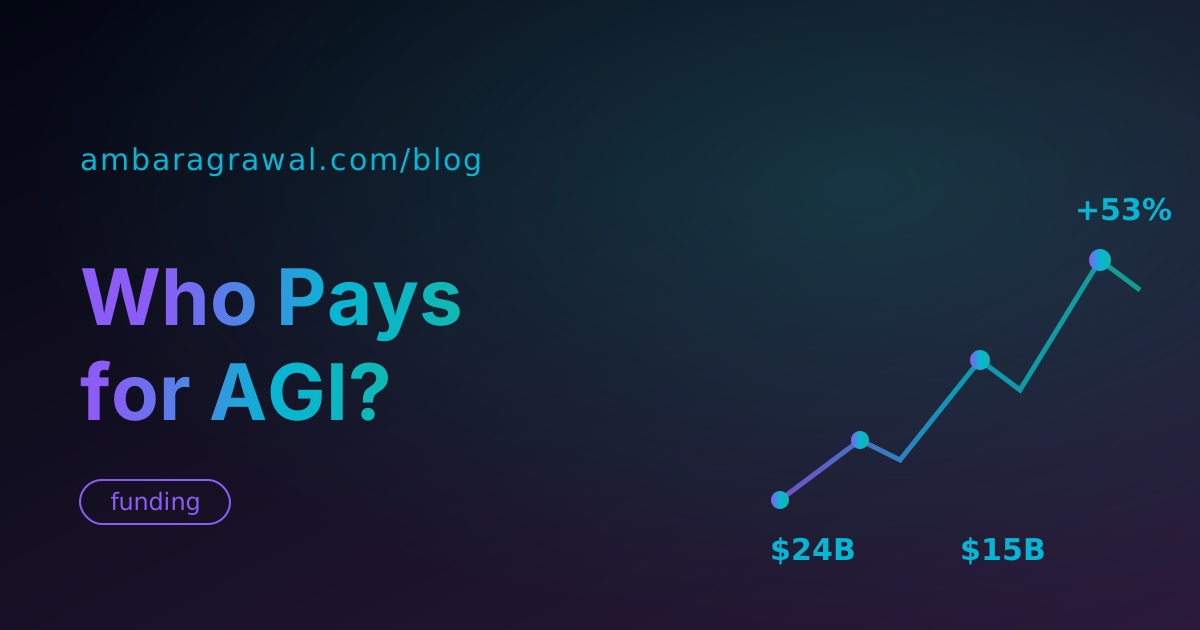
The foundry behind nearly every AI accelerator posted record monthly revenue. When the arms dealer reports 53% growth, the war is expanding: every lab's roadmap converts directly into wafer demand.
Qualcomm–Amazon: $4B in warrants
Warrants letting Amazon acquire $4B in Qualcomm stock as part of an AI infrastructure deal: hyperscaler silicon hedging. The cloud giants are vertically integrating down to the chip.
What is Anthropic's IPO really testing?
The strangest capital story of the week: Anthropic planning a fall IPO while a researcher resigns over safety, its alignment lead cites >10% extinction odds, and it fights the Pentagon over weapons-safeguard blacklisting (a judge ruled the DoD designation unlawful, yet the military reportedly still deploys Claude in missions). The IPO tests a live question: do public markets discount safety drama?
bull case:  frontier revenue + TSMC-proven demand + legal win vs Pentagon
bear case:  resignations + bioweapon-misuse headlines + RSI warnings from own staff
market's job: price the gap between capability value and governance risk
Why founders should watch this
Anthropic's listing sets the comp for every AI startup's next round. A strong IPO says capability growth outweighs all controversy: valuations everywhere float up. A weak one says governance risk is now a line item in every term sheet. Either way, your fundraising deck inherits the verdict.
What does the capex trail actually mean?
Three structural reads, in increasing order of confidence:
- Compute is the moat, models are the rent. Nobody in this week's money is buying model weights: they're buying watts, wafers, and land. The scarce layer is physical. If you're a startup, that's liberating: compete in applications, rent the moat.
- Geography is strategy. Finland (power + cooling), Samsung (fab + devices), Finland-again via EU sovereignty narratives: AI infrastructure is industrial policy now. Site selection and state partnerships belong in infra planning, not just tax planning.
- Demand is not the question; supply is. TSMC can't print wafers fast enough; Google can't build data centers fast enough. Every bottleneck in this stack is upstream. That means application-layer builders face the opposite problem, abundant models, scarce attention, which is exactly where differentiation lives.
Where does that leave startups?
Should an early startup raise for GPUs?
Almost certainly not. The hyperscalers and sovereign funds are spending tens of billions to make compute rentable: your edge is workflow depth and distribution, not FLOPS ownership. Rent the frontier; own the niche. (The one exception: workloads with pathological inference economics where reserved capacity is the product.)
Is Mistral's valuation a European startup signal?
Yes, with a caveat. $24B on strategic (Samsung) capital validates the sovereign-AI thesis: governments and conglomerates will fund regional champions. But it also concentrates oxygen: European AI seed rounds now compete for attention with a national champion. Position as ecosystem, not rival.
As of September 15, 2026: the race's loudest week paired existential warnings with record spending, fear in the research notes, euphoria in the capex. Both can be true: the technology looks dangerous and inevitable, which is precisely why the money moves first and the governance follows. For builders, the instruction is simple, rent the moat, own the workflow, and read TSMC's earnings as the race's most honest press release. Start this series at the 88-hour proof.