One Robots.txt Line Will Opt You Out of Training
OpenAI, Google, Microsoft, and Anthropic said they will honor a shared robots.txt token for AI training preferences. Here is what it does and when it starts.
On this page
OpenAI, Google, Microsoft, and Anthropic said today they will honor a shared robots.txt signal for AI training preferences, so site owners can state one preference to multiple providers instead of writing separate rules for every crawler. OpenAI announced its commitment and said it aims to implement the signal in the coming months.
The mechanism is defined in an IETF Internet-Draft, draft-kelley-aipref-training-preference-signal-00, authored by Kevin Kelley of Anthropic and dated today. It introduces no new robots.txt grammar. It uses an ordinary group keyed by a policy token in the User-Agent line.
The token is __usage_ai-training. That is the whole idea.
Takeaways
- The shared token is
__usage_ai-training, written in a robots.txt User-Agent line. - A group with
Disallow: /expresses a preference against AI training for those paths. - OpenAI, Google, Microsoft, and Anthropic said they will honor it; OpenAI aims to implement in the coming months.
- It is voluntary, draft-stage, and does not replace existing crawler controls like GPTBot.
What does it look like?
A site that wants to opt out of training across participating providers would write a group like this:
User-Agent: __usage_ai-training
Disallow: /
Allow: /press-kit/
That expresses a preference against AI training for every path except /press-kit/. The draft keeps the existing robots.txt path language, longest-match precedence, and group structure, so parsers that do not implement the token ignore it as they would any unknown user agent.
Wildcard groups are explicitly not treated as matching the policy token. If no group in the file contains the token, no preference has been expressed.
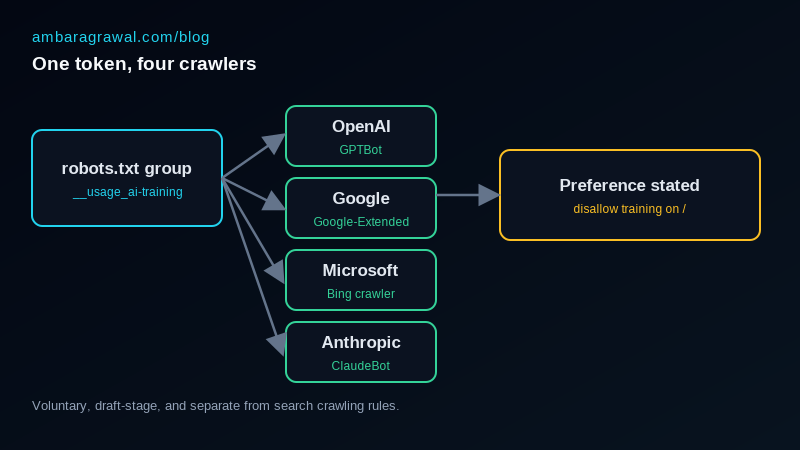
One group, four providers: the point of a shared token is that publishers stop maintaining per-crawler rules.
Why is this better than the status quo?
Because the current system is a mess of per-vendor user agents. A publisher that wants to opt out has to know about GPTBot, Google-Extended, ClaudeBot, and a growing list of others, and keep the rules in sync as vendors change names.
A shared token reduces that to one group. It is less error-prone, easier to audit, and cheaper to maintain. The draft also supports path-specific preferences, so a publisher can allow training on press releases and block it on articles.
What it is not
The token is a preference, not a directive for crawling behavior. It does not block a crawler from fetching a page for search or user-triggered visits. It is also voluntary: the draft says it does not ensure preferences are followed, and private agreements can override it.
Is it enforceable?
No, and the draft is honest about that. It leaves the choice of whether to follow the preference to the recipient. The four labs' commitments are public statements, not contracts.
That is still a meaningful step. A public commitment creates reputational cost and a paper trail. It also gives regulators and customers a standard to point to when a lab's behavior does not match its stated policy.
The draft status matters too. An individual Internet-Draft is not endorsed by the IETF and has no formal standing. It can change or expire. The vocabulary draft it relies on is a working group document that explicitly says it does not yet reflect consensus.
What should publishers do now?
Add the group, keep the old rules
Write the __usage_ai-training group alongside your existing per-bot rules. Do not remove GPTBot or other controls until implementing parsers are confirmed in the wild.
Be specific about paths
Use Allow and Disallow to protect the content that matters, like articles and datasets, while leaving marketing pages crawlable. A blanket block can hurt search visibility.
Log and verify
Watch crawler traffic after the change. A policy token does not change crawling behavior by itself, so verify that the bots you expected to respect it actually do.
Keep a copy of your terms
If you license content, put training restrictions in the contract too. Robots.txt is a signal; a license is enforceable.
What to watch
Implementation dates, which is why OpenAI's "coming months" is vague. Watch for the first provider to publish parser behavior and for the IETF draft to advance or change. And watch for the first dispute: a publisher that sets the token and finds a participant crawling anyway will test whether the commitment means anything.
The open web has needed a shared preference signal for years. This one is a draft with four signatures. That is a start, not a standard.