Marvell's $115B Bet: Optics Is the New Bottleneck
Marvell is buying Lumentum in a $115B all-stock deal to combine electrical and optical connectivity. As copper runs out of headroom, light becomes the constraint.
On this page
Marvell agreed to acquire Lumentum today in an all-stock deal valued at about $115 billion, combining the electrical interconnect and custom silicon business with Lumentum's lasers, optical transceivers, and optical circuit switching. Lumentum shareholders get 4.500 Marvell shares per share, implying about $1,132 per share and a 23.9 percent premium to the October 28 close.
The strategic logic is in one sentence from the announcement: AI bandwidth requirements are growing, and copper is hitting physical limits. The industry is moving from discrete electrical components toward integrated optical solutions that require close co-design of both.
That makes this deal less about cost synergies and more about position. If optical connectivity becomes the bottleneck in AI clusters, the company that owns both ends of the signal chain sets the standard.
Takeaways
- $115B all-stock deal, 4.500 exchange ratio, 23.9% premium to the pre-rumor close.
- Marvell holders will own about 67%; Lumentum holders about 33%.
- The companies cite copper's physical limits and the shift to optical interconnect.
- Expected close is the first half of 2028, subject to approvals.
Why is optics the next bottleneck?
Because AI clusters are becoming bandwidth-bound before they are compute-bound.
Training and inference require moving enormous amounts of data between accelerators, memory, and storage. Copper works well over short distances and low bandwidth. As speeds rise, copper loses signal integrity and burns more power per bit. Optics moves data farther with less loss and better energy efficiency.
The hard part is integration. An optical link is not a drop-in replacement for a copper cable; it requires lasers, modulators, photodetectors, and packaging that co-design electrical and photonic components. That is why Marvell is buying a company with compound semiconductor manufacturing rather than building it.
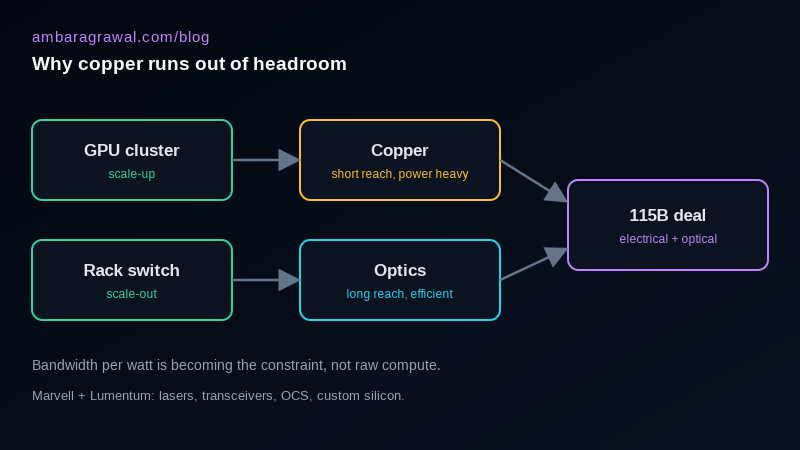
The interconnect layer is becoming the constraint as bandwidth per watt replaces raw compute as the scarce resource.
deal:        all-stock acquisition
value:       $115B implied enterprise value
terms:       4.500 MRVL shares per LITE share, ~$1,132/share
premium:     23.9% to October 28 close
ownership:   Marvell ~67%, Lumentum ~33%
TAM:         $550B combined, per the companies
synergies:   >$1B annual run-rate target
close:       first half of calendar 2028
What does the combined company get?
A full-stack connectivity portfolio: Marvell's electrical and optical interconnect, switching, custom XPU, and advanced packaging, plus Lumentum's high-power lasers, transceivers, optical circuit switching, and indium phosphide manufacturing.
The companies say the combination enables "extreme co-design," meaning electrical and optical teams optimize the link together rather than handing off specifications. They also cite a $550 billion total addressable market and more than $1 billion in annual cost synergies.
Those are the standard claims of a large merger. The more credible argument is supply: Lumentum's laser and compound semiconductor capacity is scarce, and owning it gives Marvell control over a constraining input.
The timing signal
The deal was announced two days after Lumentum's stock moved on speculation, and the premium is measured against the pre-rumor close. That is a disciplined structure. It also means the market had already begun pricing optics as a strategic asset.
What does it mean for AI infrastructure?
Three things.
Optics gets consolidated. If the deal closes, one of the few independent suppliers of high-performance lasers and optical switching becomes part of a larger chip company. Customers who valued a merchant supplier now have fewer options.
Copper's runway shortens. The industry's roadmap tilts further toward optical links inside the rack, not just between racks. That changes packaging, thermal design, and test.
The bottleneck moves. When compute was scarce, GPUs were the constraint. When power became scarce, grid connections were. If bandwidth is next, optics and the companies that make it become the choke point.
What should builders and operators do?
Ask about interconnect in your capacity plans
When you buy compute, ask what interconnect the cluster uses and whether it can scale to the next generation. Bandwidth, not FLOPs, may limit your utilization.
Track supplier concentration
Optical components are a small number of suppliers. If a merger narrows that list, qualify a second source before you need it.
Model power per bit
Interconnect is now a meaningful share of cluster power. Efficiency improvements in optics translate directly into capacity.
Do not assume the deal closes
A 2028 close leaves time for regulatory review and market change. Plan for the possibility that the companies remain independent.
What to watch
Regulatory review, shareholder votes, and whether other optics suppliers get bid up. Watch also for customer reaction: hyperscalers prefer multi-source supply, and a narrower market may push them to fund alternatives.
The AI build-out has moved from chips to power to bandwidth. Marvell is betting $115 billion that light is the next layer of the stack.