Claude Solved a 25-Year Crypto Mystery in 30 Minutes
Claude traced the NIST ECDSA curve seeds to a 1990s C library PRNG seeded with timestamps, ending years of backdoor speculation. The method matters more than the answer.

On this page
Anthropic published a report today describing how an internal Claude model solved a 25-year-old cryptography mystery in under half an hour. The NIST elliptic curve seeds, long suspected of hiding a deliberate backdoor, turned out to be the output of lrand48, a standard C library random number generator, seeded with Unix timestamps from 1997 and 1998.
The finding ends years of speculation. It also demonstrates something more useful for builders: a model with the right tools and a verifiable target can do scientific auditing work that humans had stopped attempting.
Anthropic's write-up is unusually detailed. It includes the scanner Claude wrote, the statistical tell that identified the generator, the LLL lattice method used to recover state from truncated outputs, and the code to reproduce every seed.
Takeaways
- NIST's ECDSA seeds came from lrand48 seeded with 1997–98 Unix timestamps, not a hashed passphrase.
- Claude found the pattern and recovered the generator state in under 30 minutes.
- This makes a deliberate backdoor less plausible; it is not a break and requires no action.
- Anthropic published reproduction code and donated the $36,864 bounty to ISRG.
What was the mystery?
NIST standardized ECDSA in 2000. For each curve, the specification published a "seed" whose hash defines a curve coefficient. The seeds came from the NSA with no explanation. For 25 years, cryptographers could not tell whether they were arbitrary, generated from a passphrase, or chosen to produce a weakened curve.
The leading theory, from a 2015 comment by NSA's Jerry Solinas, was that the seeds came from hashing a humorous phrase. Searches for that phrase failed. Solinas died in 2023, and the trail went cold.
How did Claude find it?
It stopped looking for the phrase and started modeling the software.
Claude guessed the seeds came from a 1990s C library PRNG, whose output is weak enough to recognize. It wrote a scanner that slid along each seed one bit at a time and tested whether adjacent chunks were consecutive outputs of a known generator. It covered 34 combinations of generator and output slice.
Then it noticed a statistical tell: in four of the ten seeds, the top bit of all 20 words was zero. That happens by chance with probability about 1 in 5,810. The pattern is a signature of lrand48, which returns only the top 31 bits of a 48-bit state.
generator:  lrand48 (48-bit linear congruential)
seed:       Unix timestamp via srand48
dates:      May 1997 – April 1998
method:     bit-scan for consecutive outputs, then LLL state recovery
time:       under 30 minutes for the NIST prime curves
byproduct:  base points for six curves traced to FreeLIP seeds
open:       one binary seed (B-163) and four NIST base points unexplained
Recovering the full state required solving a truncated linear congruential generator, which Claude did with the Lenstra–Lenstra–Lovász lattice algorithm. Stepping the state backwards produced srand48 initializations that decoded to timestamps between May 1997 and April 1998.
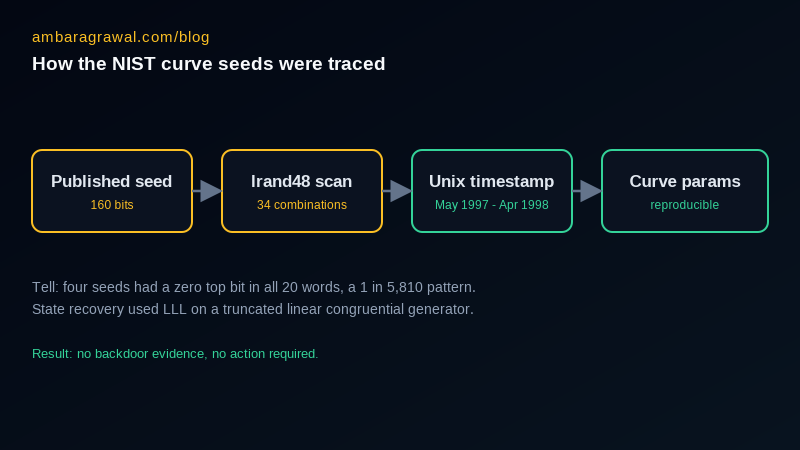
The trace from published seed to generator state to timestamp, reproducible with the code Anthropic published.
Why does this matter?
Three reasons, in increasing order of importance.
It resolves a trust question. The seeds are reproducible, ordinary, and unremarkable. That makes intentional subversion much less likely. Anthropic is careful to say this is not proof of safety, only evidence against one specific conspiracy.
It demonstrates AI as an auditor. The model did not reason its way to a new theorem. It formed a hypothesis about legacy software, wrote a scanner, noticed a statistical anomaly, and applied a known algorithm to recover state. That is the shape of a lot of real research.
It shows reproducibility as the standard. Anthropic published code that regenerates every seed and six base points. Anyone can check the claim. That is a much higher bar than a blog post saying "the model figured it out."
The detail worth stealing
Claude's own reasoning included a moment of doubt: is this a simulated test environment? It checked the match length, ran the numbers, and concluded the result was real. That self-skepticism is a feature, not a bug. Build agents that ask "is this too good to be true?" before they report success.
What is still unexplained?
Not everything fell out. One binary seed, B-163, does not fit the pattern. The base points for P-224, P-256, P-384, and P-521 were not recovered, though six others were traced to FreeLIP, Arjen Lenstra's long-integer package. And some viable curves were skipped during generation, for reasons Anthropic cannot determine.
Anthropic says the skipped candidates do not suggest weakened curves were selected. The number is small, and selecting a weakened curve would imply such curves are common and easy to find.
What should builders take from it?
Give the model a verifiable target
The seed values were checkable by direct computation. That let the model test hypotheses instead of generating plausible stories. Prefer tasks where a result can be verified mechanically.
Let it write the scanner
The breakthrough came from code that tested thousands of hypotheses, not from a single clever sentence. Agentic research is mostly tool-building plus iteration.
Publish the reproduction path
If your AI system produces a surprising result, ship the code and data that let someone else check it. Otherwise the result is a demo, not a finding.
Do not over-read the result
This is not a break, a vulnerability, or a reason to rotate keys. Anthropic says there is no action to take. Resist the urge to turn a good story into a security panic.
What to watch
The remaining open questions are narrow: B-163, the four NIST base points, and the skipped candidates. None of them affect deployed systems. The broader question is whether labs start using models for this kind of legacy-software archaeology more often. The cost of trying just fell to half an hour.