The Best Language for Coding Agents Is Go?
Developers argue Go beats Python and Rust for AI-written code. What the MirrorCode study found, why strict languages win, and how to pick yours in 2026.
On this page
Ask a room of developers which language AI coding agents write best, and a surprising consensus forms: Go. Not the agents' favorite (they'll reach for Python unprompted), but the language where agent output needs the least cleanup. A viral thread this month, plus the MirrorCode study testing agents across six languages, finally gives the debate data. Here's what matters and how to choose.
Takeaways
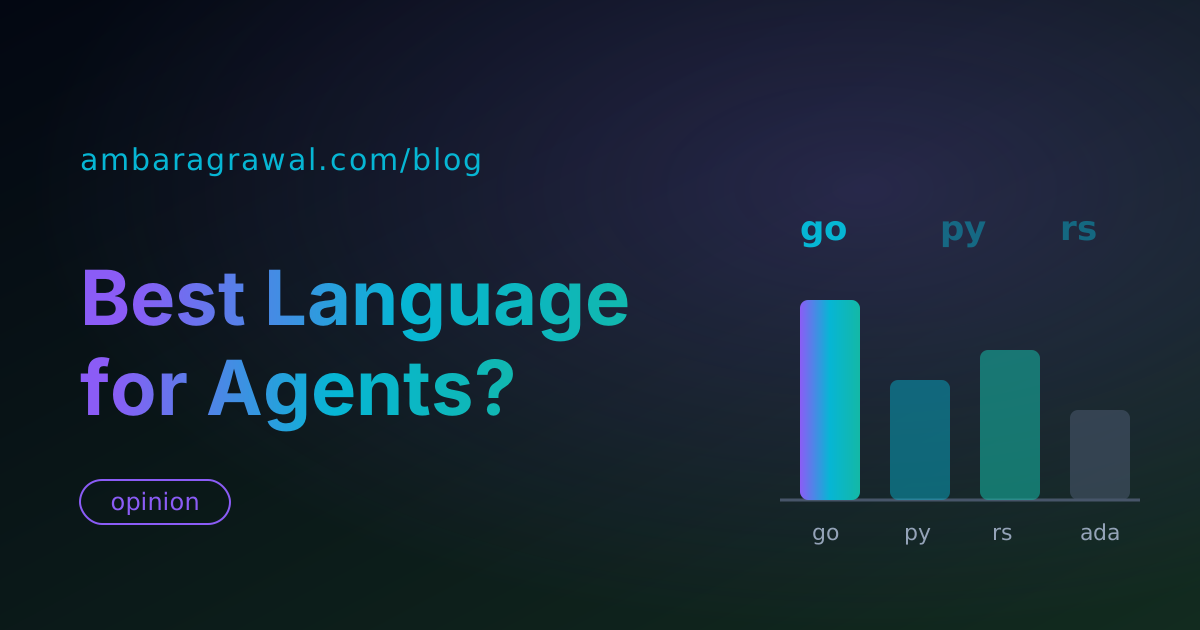
Practitioners rank Go first for agent output quality: one idiom, consistent training data, fast compiler feedback. MirrorCode's data says solve rates barely differ by language, but token cost does (Python cheapest, Ada dearest). The real variable isn't the language, it's the feedback loop: types, linters, and tests that let agents check their own work. Strict Python (ruff + pyright) or TypeScript gets you most of Go's advantage without switching stacks.
Why does Go win the practitioner vote?
Three reinforcing reasons surface again and again:
- One way to do things. Go's deliberately small surface, no generics-era cleverness in most codebases, standard formatting via
gofmt, idiomatic error handling, means the training data is stylistically consistent. Agents imitate the median of what they've seen; Go's median is clean. - Clean training signal. Contrast Python, whose corpus mixes world-class libraries with millions of one-off scripts by non-engineers demonstrating "many different ways of doing the same thing." The agent's default sample from that distribution is measurably sloppier.
- Compiler as reviewer.
go buildis fast, deterministic, and total: entire bug categories (unused imports, type mismatches) die before a human ever reads the diff. Agents that can run the toolchain iterate toward correctness autonomously.
The steelman for your current stack
Nobody in the thread argues for rewriting in Go. The argument is about properties, strictness, uniformity, tooling, which you can bolt onto Python (ruff, strict pyright), TypeScript (strict mode, eslint), or Rust (the compiler itself). Adopt the properties, keep the language.
What does the data actually say?
The MirrorCode paper tested Claude Opus 4.7 and GPT-5.5 across Python, C, Rust, Go, OCaml, and Ada on 19 very long-horizon tasks, and found little sign of inter-language differences in solve rates. Models appear to have learned generalized programming skill, not syntax pattern-matching. The measurable difference was cost: successful Python solutions used fewer tokens than average, Ada more.
solve rate by language:  ~flat across all six
token cost (relative):   Python < Go ≈ Rust ≈ C < OCaml < Ada
agent's unprompted pick: Python (scripts) / JS (web glue)
practitioner's pick:     Go (services) / Rust (systems) / typed Python (data)
Reconciling the anecdote with the data: benchmarks measure whether the agent solves the task; developers care whether the solution is maintainable through ten more iterations. A dynamic language lets small misunderstandings compound across sessions, stale names, shadowed builtins, untyped boundaries, until neither human nor agent can safely change the code. Strictness pays off over time, not per task.
How should you pick for your agent workflow?
A decision procedure distilled from the thread:
Keep the language humans must maintain
If people still review and own the code, their readability dominates: "the preference of the developers is of primary concern, not the agent." Never switch languages for the agent's sake alone.
Maximize machine-checkable feedback
Rank your setup by how much the agent can verify without you: compiler errors, type errors, lint failures, test results, headless-browser checks. Every loop you automate is review time you reclaim: agents that can run go build or pyright fix whole classes of bugs before the diff reaches you.
Enforce one style mechanically
gofmt, ruff format, prettier, plus the linter in CI, not just in the editor. Agents conform to enforced constraints far better than to style-guide prose in AGENTS.md.
Fence the failure modes per language
Python: mandate type annotations on agent-written code and strict pyright. TypeScript: no any from agents. C#: ban reflection unless justified. Rust: accept slower builds as the price of fearless agent iteration.
What about the exotic picks?
Two minority reports worth noting. OCaml gets the most passionate single-vote ("quality and performance of the code is just phenomenal"): Jane Street's modernized tooling plus a small, expert corpus. Elixir has a structural argument: the BEAM swaps modules live, so agents can "implement batches and see changes take effect in real time" with no restart. Both suffer the same fatal flaw for most teams: thin training data and few colleagues who can review the output. Fascinating; not advisable unless you're already there.
Where does that leave agent-written code?
Should new projects default to Go for agents?
If it's a CLI, service, or web backend with no other constraints: the thread's answer is genuinely yes. For data work (Python's ecosystem), browser code (TypeScript), or systems (Rust), add strictness mechanically instead of switching.
Do I need to police which language the agent uses?
Yes, lightly. Unsupervised agents default to Python scripts and throwaway glue even inside Go or Rust repos. One line in your agent instructions, "implement in the repo's primary language; scripts only in /scripts", prevents most drift.
As of September 14, 2026: the language debate resolved into something more useful than a winner: a checklist. Strict types, one enforced style, and a toolchain the agent can run itself. Get those three and the agent writes maintainable code in whatever language your team already owns. Pair this with the permission-scoping patterns and your agents are both leashed and legible.