How to Read Anthropic's $80.7B Loss
Anthropic filed its S-1 for a Nasdaq listing under ANT. The reported $80.7B net loss is mostly a non-cash charge, and that distinction is the whole story.
On this page
Anthropic filed its S-1 today, setting up a Nasdaq listing under the ticker ANT. The filing does not include a share count or price range yet, which is normal for a first public draft. It does include the numbers everyone has been waiting for.
Reported figures put first-half 2026 revenue at $16.3 billion and net loss at $80.7 billion. That loss number is already being quoted as evidence that the AI business model is broken. It is mostly an accounting charge, and the distinction matters more than the headline.
Anthropic's filing announcement is deliberately dry: a registration statement, a proposed offering, no price. The interesting material is in the prospectus, and the first job is reading it correctly.
Takeaways
- Anthropic filed Form S-1 for a Nasdaq IPO under ANT; no price range yet.
- Reported H1 revenue was $16.3B; reported net loss was $80.7B.
- Most of that loss is a non-cash charge, not cash leaving the business.
- The durable questions are compute commitments, customer concentration, and gross margin.
What is actually in the numbers?
A GAAP net loss includes non-cash items: stock-based compensation, valuation changes, and accounting charges that do not involve writing a check. A cash burn number tells you how much money the company actually spent.
The reported $80.7 billion loss is dominated by a non-cash charge, according to coverage of the filing. Revenue of $16.3 billion against that loss is a strange ratio precisely because the two numbers measure different things. One is a legal accounting result; the other is a measure of demand.
filing:      Form S-1, SEC
listing:     Nasdaq, ticker ANT
revenue:     $16.3B, first half 2026 (reported)
net loss:    $80.7B, first half 2026 (reported)
composition: mostly non-cash charge (reported)
price range: not yet determined
underwriters: Goldman Sachs, Morgan Stanley
None of that makes the loss irrelevant. It means you cannot compare it to revenue and conclude anything useful. You need the cash flow statement and the notes.
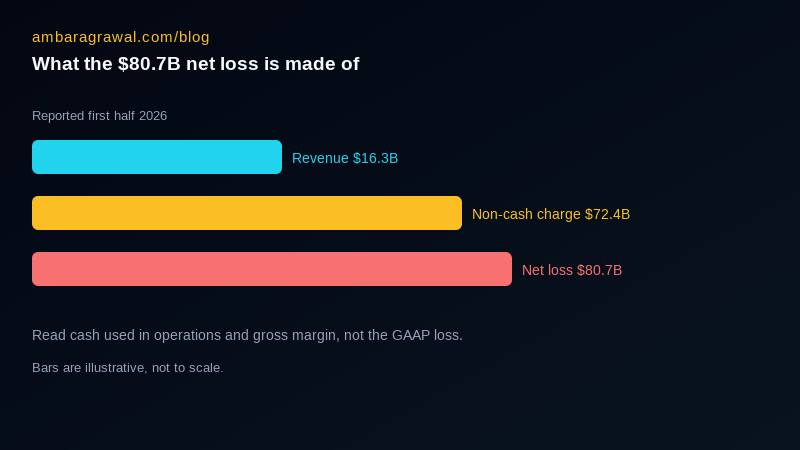
The composition matters more than the total. Bars are illustrative, not to scale.
Why is the loss so large?
Without the full prospectus, the safest explanation is the one the reporting supports: a large non-cash charge tied to how the company values something, not to operations. That could be stock compensation, convertible instruments, or a revaluation. Each has different implications.
The more important number is gross margin. If Anthropic earns $16.3 billion in revenue and spends most of it on inference and compute, the business is a scale game with thin margins. If gross margin is healthy, the loss is a financing artifact. The S-1 will show which.
The comparison that matters
Do not compare Anthropic's net loss to its revenue. Compare cash used in operations to revenue, and gross profit to revenue. Those ratios tell you whether the business gets healthier or worse as it grows.
What else should readers look for?
Four items, in order.
Compute commitments. Long-term contracts for data centers and chips are the largest hidden liability in AI. They determine how much the company must spend even if demand slows.
Customer concentration. If a handful of customers account for most revenue, the business is fragile. Watch the percentage and the contract lengths.
Gross margin trend. A company with improving gross margin as it scales is a different investment from one whose margin falls with volume.
Governance. Dual-class shares, board structure, and the role of the public benefit corporation charter all affect how much control founders retain.
Why go public now?
Because the private market has priced the company, and public markets are the next source of capital at scale. Anthropic raised at a reported $965 billion valuation in May, and reports before the filing suggested it was seeking $1.5 trillion to $2 trillion in a debut.
An IPO also creates a public currency for acquisitions and employee compensation, and it forces disclosure that customers and regulators have been asking for. The cost is quarterly scrutiny of exactly the numbers above.
What should builders and buyers take from it?
Read cash flow, not headlines
When the S-1 is public, start with cash used in operations and gross margin. The net loss is an accounting conclusion, not a business verdict.
Check compute commitments against your own
If your vendor has long-term capacity obligations, its pricing and priorities will reflect them. A supplier under commitment pressure makes different choices.
Watch customer concentration
A platform dependent on a few large customers may prioritize them over smaller developers. Read the concentration disclosure and plan accordingly.
Do not copy the valuation into your model
A $1.5 trillion valuation is a price, not a forecast. Build your cost model on published API prices and your own usage.
What to watch
The amended S-1 with a price range, the gross margin disclosure, and the compute commitment table. Then the first quarterly report as a public company, which will show whether the trend lines in the prospectus held.
Anthropic is the first frontier lab with a public S-1. Whatever the stock does, the document will become the reference for how the industry talks about AI economics.