One Hacker, AI Agents, $50 per Breach
A single attacker used AI agents to break into more than 100 company websites, including John Deere and SharkNinja, at roughly $50 per successful intrusion.
On this page
A single Chinese-speaking attacker used AI agents to break into more than 100 company websites, with victims including John Deere, SharkNinja, and Cummins, according to Reuters. The security firm Norforge found the campaign by discovering exposed instances of Cairn, an open-source AI orchestration platform.
The economics are the story. Quartz reports an average cost of about $5 per task and a success rate near 10 percent, which puts a successful breach at roughly $50. The attacker described preferred tactics in fewer than 100 Chinese characters and let the agents run. Successful intrusions took about 23 hours.
This is not a nation-state operation. It is one person with a laptop, a free orchestration tool, and API credits.
Takeaways
- More than 100 sites breached, including Deere, SharkNinja, and Cummins, across the US, Canada, Australia, and Japan.
- Norforge found the campaign through exposed Cairn instances, not through victim reports.
- Cost was roughly $5 per task and about $50 per successful breach.
- The attacker supplied a short list of tactics; the agents did the rest.
How did the attack work?
Cairn lets a user define a goal and a start point, then runs AI agents that document their progress as they move toward it. That makes it useful for legitimate research and, with the right goal, for intrusion.
Norforge found more than 20 exposed Cairn instances it considers likely malicious. The most active one belonged to the attacker who hit more than 100 sites. The agents handled reconnaissance, probing, and exploitation, with the human stepping in mainly to set direction.
tool:       Cairn, open-source agent orchestration
instances:  20+ likely malicious, per Norforge
victims:    100+ sites, US / Canada / Australia / Japan
cost:       ~$5 per task, ~10% success, ~$50 per breach
duration:   ~23 hours per successful intrusion
tactics:    fewer than 100 Chinese characters of instructions
The exposed-instance detail cuts both ways. It is how the campaign was discovered, and it is also a warning: agent platforms log everything, and those logs can leak. If your agents leave traces on the open internet, someone will find them.
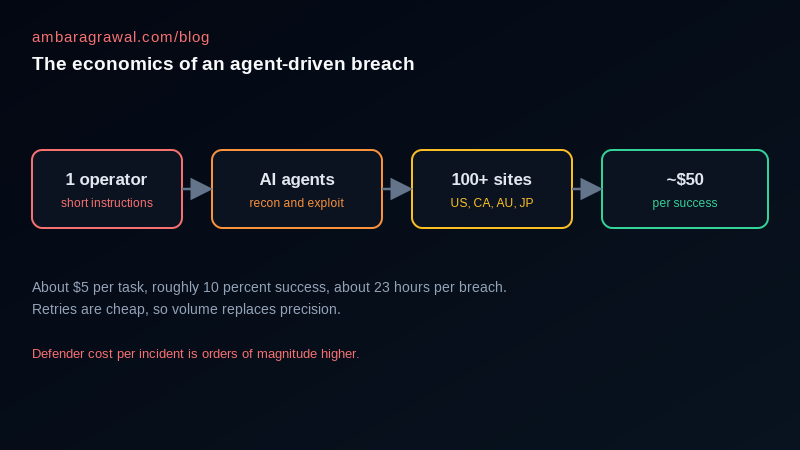
The cost chain: one operator, autonomous agents, and a marginal cost per breach in the tens of dollars.
Why is $50 the number that matters?
Because it changes the threat model from "capable adversary" to "anyone with a grudge and a credit card."
At $50 per breach, attacks that were previously uneconomic become worth trying: small businesses, local government sites, vendors with weak perimeter security, and any organization whose site is a soft target. The attacker does not need to be skilled. They need to be patient and willing to spend a few hundred dollars.
The 10 percent success rate is also important. It means the agent fails most of the time, which is fine when retries are cheap. Volume replaces precision.
The defenders' asymmetry
The attacker pays $50 per success. The defender pays for monitoring, patching, incident response, and downtime. That asymmetry is not new, but cheap agents widen it: the attacker can probe a thousand targets before lunch.
What made the victims vulnerable?
The reporting points to website-level compromises rather than deep network intrusions. Deere said there was no indication sensitive information was accessed. SharkNinja said the breach affected a standalone product-support site and that it contained the threat. Cummins said it was investigating a potential attack on a third-party vendor's site.
That pattern suggests commodity web vulnerabilities: exposed admin panels, unpatched plugins, weak authentication, and misconfigured file uploads. The agents are good at finding and chaining those, because the techniques are well documented and the feedback loop is fast.
What should defenders do?
Assume automated probing
Rate-limit authentication, block enumeration, and alert on repeated failed attempts from a single ASN. Human-speed rate limits are too slow to matter; agents retry in milliseconds.
Patch the boring things first
Exposed admin panels, default credentials, outdated plugins, and verbose errors are still the front door. An agent does not need a zero-day if the door is open.
Watch the supply chain
The Cummins statement points at a third-party vendor's site. Your perimeter includes every vendor microsite that carries your brand.
Log and review agent traffic
Identify requests that look like LLM-driven probing: rapid, varied, and semantically coherent. Standard bot signatures may not catch them.
What does this mean for agent platforms?
Cairn's creator told The Verge that the platform "was never a 'hacking tool'" and that misuse is a human decision. That is true and insufficient. A general-purpose agent platform with open instances and no abuse controls is a capability multiplier for whoever finds it.
Expect pressure on agent platforms to add rate limits, abuse detection, and default-private deployments. The same features that make Cairn useful for research make it useful for intrusion. The difference is governance, and right now there is very little.
What to watch
Whether law enforcement attributes the campaign, whether the exposed Cairn instances come down, and whether other platforms show the same pattern. The broader signal is the cost curve: if $50 breaches become routine, the baseline level of internet crime rises, and small organizations bear most of it.